As urban environments rapidly evolve, modern master planning increasingly favors high-density, mixed-use smart cities. These developments blend residential apartments, commercial offices, retail outlets, entertainment venues, and light industrial facilities into integrated urban spaces. Enhanced by Internet of Things (IoT) sensors, automated energy management, and data-driven infrastructure, smart cities offer unprecedented operational efficiency and sustainability. However, this high level of integration and density introduces unique fire safety challenges that demand a modernized approach to emergency preparedness.
- The Complex Risk Profile of Mixed-Use Smart Developments
Unlike traditional single-use zoning, mixed-use smart environments host diverse occupational hazards within a single structure or interconnected precinct:
-
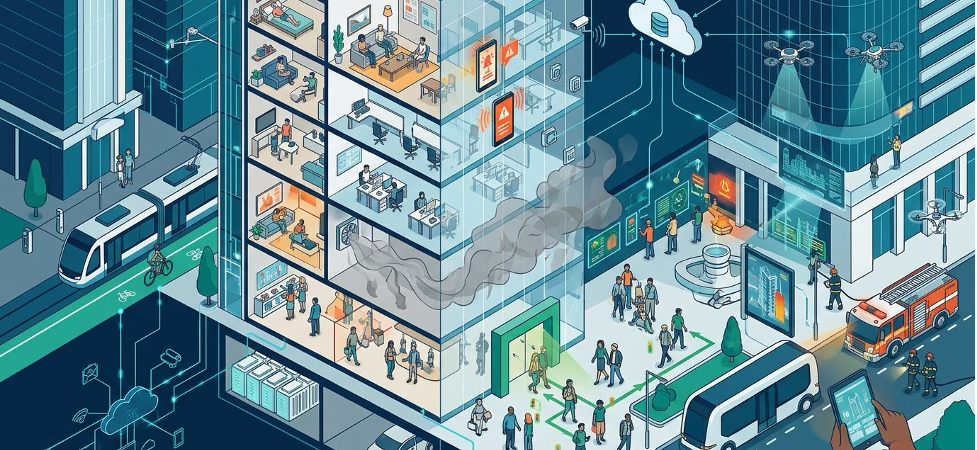
- Varied Fuel Loads and Hazards: A single building might house a commercial kitchen on the lower floor, a high-density lithium-ion battery energy storage system (BESS) in the basement, data servers on middle floors, and hundreds of residents above. Each zone presents distinct ignition risks, smoke progression profiles, and fire suppression demands.
- Complex Occupancy Patterns: Smart districts operate around the clock. Varying occupant densities, changing demographics throughout the day (workers, shoppers, residents, and tourists), and differing levels of familiarity with evacuation routes complicate emergency planning.
- Vertical and Horizontal Fire Propagation: Integrated infrastructure—such as continuous utility shafts, shared HVAC systems, and architectural facades—can create unhindered pathways for heat, toxic gases, and flames if compartmentalization is breached.
- Leveraging Smart Technology for Fire Prevention and Early Detection
Smart city infrastructure provides powerful capabilities to transform fire safety from reactive response to proactive management:
-
- IoT-Enabled Multi-Sensor Networks: Beyond standard optical smoke detectors, modern smart buildings deploy multi-sensor systems capable of detecting trace gases, rapid temperature spikes, and off-gas emissions from overheating batteries before visible smoke or flames appear.
- AI-Driven Predictive Analytics: Building management systems (BMS) integrated with Artificial Intelligence can continuously evaluate sensor data against environmental baselines. Predictive algorithms can identify anomalous thermal signatures or electrical system degradations, enabling targeted maintenance before an ignition event occurs.
- Dynamic Digital Twins: A digital twin—a real-time 3D virtual model of the physical environment—allows emergency responders and facility managers to monitor structural status, occupant movement, and environmental parameters in real time. During an incident, the digital twin can simulate smoke movement and structural heat build-up to aid tactical decision-making.
- Integrated Emergency Response and Building Automation
When a fire incident occurs, smart city automation can immediately coordinate localized containment and occupant guidance:
-
- Automated Containment and Ventilation Control: Connected HVAC and dynamic smoke management systems automatically isolate affected zones, pressurize stairwells to prevent smoke ingress, and activate targeted extraction fans to maintain clear evacuation routes.
- Adaptive Wayfinding and Intelligent Evacuation: Static exit signs are replaced with dynamic, smart-guided evacuation systems. Using real-time sensor data, these systems direct occupants away from smoke-filled corridors and active fire zones toward the safest active exit pathways using directional lighting, localized public address announcements, and mobile alerts.
- Automated First Responder Integration: Smart alarm systems immediately transmit high-fidelity data to emergency operations centers. First responders receive crucial pre-arrival intelligence, including exact fire origin, structural layouts, active suppression status, hazardous material locations (such as battery banks), and real-time occupant counts.
- Key Challenges and Considerations
While smart technology offers massive advantages, it also introduces systemic vulnerabilities that require careful mitigation:
-
- Cybersecurity and System Resilience: Connected fire safety systems are potential targets for cyber threats. A cyberattack targeting building automation could blind sensors, disable suppression valves, or spoof alarm systems. Ensuring robust encryption, air-gapped safety-critical fallbacks, and zero-trust architectures is essential.
- Power and Network Failover: Smart safety features rely heavily on power and network connectivity. Fire safety protocols must include fail-safe physical backups, robust secondary power systems, and decentralized local processing (edge computing) so that core detection and suppression mechanisms remain fully operational during a total grid or network outage.
- New Technical Hazards (Energy Storage Systems): The rapid adoption of renewable energy and battery storage systems (BESS) in smart cities presents severe thermal runaway risks. Fire preparedness plans must incorporate specialized suppression systems (such as water-deluge cooling or specialized gas agents) tailored for electrical and chemical energy storage fires.
- Strategic Recommendations for Urban Planners and Safety Leaders
Preparing mixed-use smart cities for fire hazards requires a holistic combination of technology, regulation, and human readiness:
-
- Adopt Performance-Based Design Standards: Modernize local building codes to accommodate smart technology integration and complex mixed-use layouts, moving beyond rigid, prescriptive rules to outcome-driven safety metrics.
- Establish Interoperable Emergency Communications: Ensure that building automation protocols (such as BACnet or Matter) seamlessly integrate with public safety software systems used by local fire departments.
- Conduct Multi-Agency Smart Simulations: Regularly perform evacuation drills and emergency response simulations using digital twin environments to test automated systems, first-responder tactics, and occupant behaviors under realistic conditions.
- Prioritize Redundancy and Human-in-the-Loop Safeguards: Ensure that every automated safety measure retains manual overrides and physical fail-safes that allow trained firefighters and site personnel to take direct control when necessary.
Conclusion
Fire safety in mixed-use smart cities demands a shift from isolated protection measures to an integrated, resilient ecosystem. By combining advanced IoT detection, artificial intelligence, automated containment, and robust fail-safe design, municipal planners and safety leaders can protect dense urban populations while preserving the efficiency and innovation that make smart cities the future of urban living.