
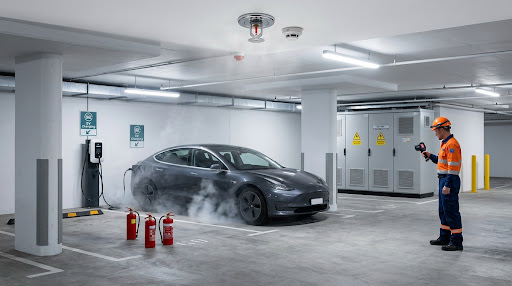
The rapid adoption of electric vehicles (EVs) and battery energy storage systems (BESS) is transforming how energy is stored, transported, and used. From electric cars and motorcycles to large-scale battery installations, these technologies offer significant environmental and operational benefits. However, they also introduce new fire risks that businesses, facility managers, and emergency response teams must understand.
Unlike conventional fires, incidents involving lithium-ion batteries can behave unpredictably and may require specialized detection, suppression, and emergency response strategies.
Understanding Lithium-Ion Battery Fire Risks
Most modern electric vehicles and battery storage systems rely on lithium-ion battery technology. These batteries store a substantial amount of energy in a relatively compact space, making them efficient but potentially hazardous when damaged, overheated, improperly charged, or exposed to manufacturing defects.
One of the primary concerns is thermal runaway. This occurs when a battery cell experiences an uncontrolled rise in temperature, triggering chemical reactions that generate additional heat. The heat can spread to neighboring cells, causing a chain reaction that may result in fire, smoke, or even an explosion.
Thermal runaway can be triggered by physical damage, electrical faults, overcharging, excessive temperatures, internal defects, or short circuits.
Fire Risks in Electric Vehicles
Electric vehicles introduce battery-related risks into locations that were traditionally designed around internal-combustion vehicles.
A damaged EV involved in a collision can present a fire hazard even when there are no immediate visible signs of battery damage. Battery fires can also occur during charging, particularly when charging equipment, electrical systems, or batteries are defective or improperly maintained.
Parking structures and enclosed garages require particular attention. Smoke, heat, and toxic gases generated during a battery fire can create difficult conditions for occupants and firefighters. EV batteries may also continue to produce heat or reignite after an initial fire has been suppressed, making monitoring and post-fire management especially important.
Facilities with EV charging stations should therefore consider charger placement, electrical protection, ventilation, emergency access, and appropriate fire detection as part of their overall fire safety strategy.
Battery Energy Storage Systems
Large-scale battery storage presents another set of challenges. BESS installations can contain thousands of individual battery cells housed within cabinets, containers, or dedicated rooms.
A failure in one cell can potentially propagate through a battery module and affect surrounding cells. If thermal runaway develops, the system may produce significant amounts of flammable and toxic gases. In enclosed spaces, these gases can accumulate and create an additional explosion hazard if they encounter an ignition source.
For this reason, simply installing a conventional fire extinguisher near a battery storage system is not an adequate fire protection strategy. The system should be designed with multiple layers of protection, including battery management systems, temperature monitoring, gas detection where appropriate, ventilation, fire detection, and carefully selected suppression measures.
Why Early Detection Matters
Early detection can be critical in limiting the consequences of a battery-related incident.
Conventional smoke detection alone may not always provide sufficient warning during the early stages of a battery failure. Depending on the installation, facilities may use a combination of smoke, heat, flame, and gas detection technologies.
Battery management systems can also monitor parameters such as temperature, voltage, and current. Abnormal readings may provide an opportunity to isolate affected equipment before thermal runaway develops.
The most effective approach is therefore not to rely on a single detection device, but to establish multiple layers of monitoring and protection appropriate to the battery technology and installation.
Fire Suppression Challenges
Battery fires can be difficult to extinguish because the source of the fire is often inside the battery cells themselves. Suppressing visible flames does not necessarily mean that the underlying thermal event has ended.
Water may play an important role in cooling batteries and preventing thermal propagation, but the appropriate firefighting method depends on the specific battery system, installation, and emergency response procedures. Fire protection systems should therefore be selected based on a professional assessment rather than assuming that one suppression agent will work for every application.
Firefighters and emergency teams should also be aware of the potential for delayed re-ignition and should follow appropriate procedures for monitoring and isolating damaged batteries.
Preventing Battery-Related Fires
Prevention begins with proper design, installation, operation, and maintenance.
For EV charging areas, facilities should ensure that electrical infrastructure is appropriately rated for the charging load. Charging equipment should be regularly inspected, and damaged cables or connectors should be removed from service.
For battery storage facilities, temperature control, battery management systems, electrical protection, spacing, ventilation, and monitoring should all be considered during the design process.
Personnel should also be trained to recognize warning signs such as unusual heat, swelling, hissing sounds, unusual odors, smoke, or abnormal battery performance. Damaged or compromised batteries should never be treated as ordinary waste or stored casually inside a facility.
Preparing Emergency Response Teams
Fire safety plans should evolve alongside new technologies. Emergency responders need to know where EV charging stations and battery storage systems are located, what types of batteries are present, and how the systems can be safely isolated.
Facilities should also establish clear emergency procedures covering evacuation, notification, electrical isolation, access for emergency services, and post-incident monitoring.
Regular drills can help employees understand how to respond quickly while avoiding unnecessary exposure to smoke, gases, and damaged equipment.
A Layered Approach to Battery Fire Safety
Modern battery technology is not inherently unsafe, but its fire risks require a different level of awareness and preparation. Relying solely on traditional fire protection measures may leave important gaps when dealing with high-energy lithium-ion batteries.
A comprehensive strategy should combine prevention, monitoring, early detection, appropriate suppression systems, electrical safety, emergency planning, and employee training.
As EV adoption and battery storage continue to grow, businesses should review their existing fire risk assessments and determine whether their facilities are prepared for these emerging hazards. Proactive planning can help reduce the likelihood of serious incidents while protecting people, property, and critical operations.
Related posts:
 Battery Storage and Fire Safety: Protecting Against New Risks
 The Role of Fire Sprinkler Systems in Reducing Fire Risks
 Green Fire Protection: Sustainable Solutions for Modern Businesses
 Fire Protection Solutions for Unique Environments (e.g., Cold Storage, Hazardous Materials)
 Fire Safety Challenges in Cold Storage and Freezer Warehouses