Fire safety training is essential in every workplace, but simply conducting a training session does not guarantee that employees will remember what they learned when an emergency occurs. In a real fire, people need to react quickly and confidently. This makes it important for organizations to design fire safety training programs that go beyond presentations and checklists.
Effective fire safety training should build practical knowledge, reinforce the right behaviors, and help employees develop the confidence to respond appropriately under pressure. When training is designed with retention and real-world application in mind, fire safety becomes more than an annual requirement—it becomes part of the workplace culture.
Why Fire Safety Training Often Fails to Stick
Many organizations provide fire safety training as a routine compliance activity. Employees attend a presentation, receive information about emergency procedures, and may participate in an evacuation drill. However, information presented only once can quickly be forgotten.
Fire emergencies also create stressful and unfamiliar situations. Employees may panic, become disoriented, or hesitate because they are unsure what to do. Knowing emergency procedures in theory is very different from being able to apply them confidently in practice.
This is why effective training should focus not only on what employees need to know, but also on what they need to do.
Start With a Clear Understanding of Workplace Risks
A strong fire safety training program should begin with the organization’s actual risks.
Different workplaces face different fire hazards. An office may need to focus on electrical equipment, cooking areas, and evacuation routes, while a warehouse may have additional risks involving combustible materials, machinery, storage arrangements, or hazardous substances.
Training should therefore be connected to the workplace environment. Employees should understand:
- The most likely sources of fire in their work area
- Where fire alarms and emergency exits are located
- How to report a fire or activate an alarm
- Which evacuation routes they should use
- Where designated assembly points are located
- Who is responsible for specific emergency roles
- When they should evacuate rather than attempt to fight a fire
When employees can connect training directly to their surroundings, the information becomes easier to understand and remember.
Make Training Practical, Not Just Theoretical
One of the most effective ways to improve retention is to make employees actively participate.
Instead of relying entirely on slides or lectures, organizations can combine several learning methods. Demonstrations, hands-on exercises, scenario-based discussions, and evacuation drills can make training more memorable.
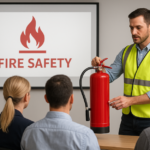
For example, rather than simply explaining how a fire extinguisher works, a qualified instructor can demonstrate the correct technique and, where appropriate and safe, allow employees to practice using suitable training equipment.
Practical training helps employees develop familiarity with emergency actions before they are required to perform them in a real situation.
Use Realistic Scenarios
Scenario-based training can help employees think through how they would respond to different emergencies.
Rather than asking only, “What should you do if there is a fire?”, training can present situations such as:
- Smoke is detected in an office area during working hours.
- A fire alarm sounds while employees are in a meeting.
- An exit route becomes unavailable.
- A colleague requires assistance during evacuation.
- A fire starts in an area where electrical equipment is being used.
Employees can then discuss the appropriate response and identify potential mistakes.
This approach encourages decision-making instead of simple memorization. It also helps employees recognize that emergency situations may not always happen exactly as described in a training presentation.
Keep the Message Simple and Consistent
During an emergency, employees do not have time to remember complicated instructions. Fire safety training should therefore prioritize clear, simple actions.
Key procedures should be communicated consistently across training sessions, signage, emergency plans, and drills. Employees should know what to do when they discover a fire, hear an alarm, or are instructed to evacuate.
Visual materials can also reinforce important information. Emergency exit maps, fire extinguisher signage, assembly-point markers, and clearly displayed emergency procedures help employees become familiar with critical information before an incident occurs.
Reinforce Knowledge Through Regular Drills
Training should not be treated as a one-time event.
Regular evacuation drills give employees opportunities to practice emergency procedures and allow organizations to identify weaknesses in their plans. A drill can reveal issues that may not be obvious on paper, such as blocked evacuation routes, unclear responsibilities, poor communication, or employees who are unfamiliar with assembly points.
After every drill, organizations should evaluate what went well and what needs improvement.
The objective should not simply be to complete the drill as quickly as possible. It should be to determine whether employees understand the procedure and whether the emergency response system works effectively.
Train Employees According to Their Roles
Not every employee has the same responsibility during a fire emergency.
Organizations may have designated fire wardens, emergency response teams, security personnel, supervisors, or other employees with specific responsibilities. These individuals may require additional training beyond general employee awareness.
Role-specific training can address areas such as:
- Coordinating evacuations
- Checking designated areas where appropriate
- Communicating emergency information
- Supporting vulnerable or mobility-impaired individuals
- Coordinating with emergency responders
- Managing assembly points
- Reporting the status of evacuated personnel
Clearly defined responsibilities reduce confusion and help employees understand who should take action during an emergency.
Use Short, Frequent Learning Opportunities
Fire safety knowledge can fade when employees receive information only once a year.
Organizations can improve retention through short reinforcement activities throughout the year. These may include brief safety reminders, toolbox talks, internal communications, refresher demonstrations, quizzes, or short scenario discussions.
For example, a monthly safety message could focus on one topic at a time, such as recognizing fire hazards, keeping exits clear, responding to alarms, or understanding evacuation procedures.
Short learning opportunities are easier to absorb and can keep fire safety awareness active between formal training sessions.
Measure Whether Training Is Actually Working
Attendance alone is not a good measure of training effectiveness.
Organizations should evaluate whether employees can demonstrate the knowledge and behaviors they are expected to have. This can be done through quizzes, observations during drills, practical demonstrations, scenario-based assessments, and feedback.
Useful questions include:
- Do employees know their nearest emergency exit?
- Can they identify the designated assembly point?
- Do they understand how to report a fire?
- Do employees know when evacuation is the appropriate response?
- Do designated emergency personnel understand their responsibilities?
- Are recurring problems being identified and corrected?
The results should be used to improve future training rather than simply recorded for compliance purposes.
Build a Culture of Fire Safety
The strongest fire safety programs are not limited to formal training sessions. Fire safety should become part of everyday workplace behavior.
Employees should feel encouraged to report hazards, keep emergency routes clear, follow safety procedures, and raise concerns when something appears unsafe. Managers and supervisors also play an important role by demonstrating that fire safety is a continuous responsibility rather than an annual administrative requirement.
When employees see safety consistently reinforced by leadership, they are more likely to treat it seriously themselves.
Make Fire Safety Training Stick
An effective fire safety training program combines relevance, practice, repetition, and evaluation.
Organizations should begin by understanding their specific fire risks, then translate those risks into clear procedures and realistic scenarios. Practical exercises and evacuation drills can turn theoretical knowledge into action, while regular refreshers help employees retain critical information over time.
Most importantly, fire safety training should prepare people for what they may actually face—not simply what they need to know for a training record.
When employees understand the risks, know their responsibilities, practice their response, and regularly reinforce their knowledge, fire safety becomes more than a compliance exercise. It becomes a capability that can help protect people, property, and business continuity when it matters most.