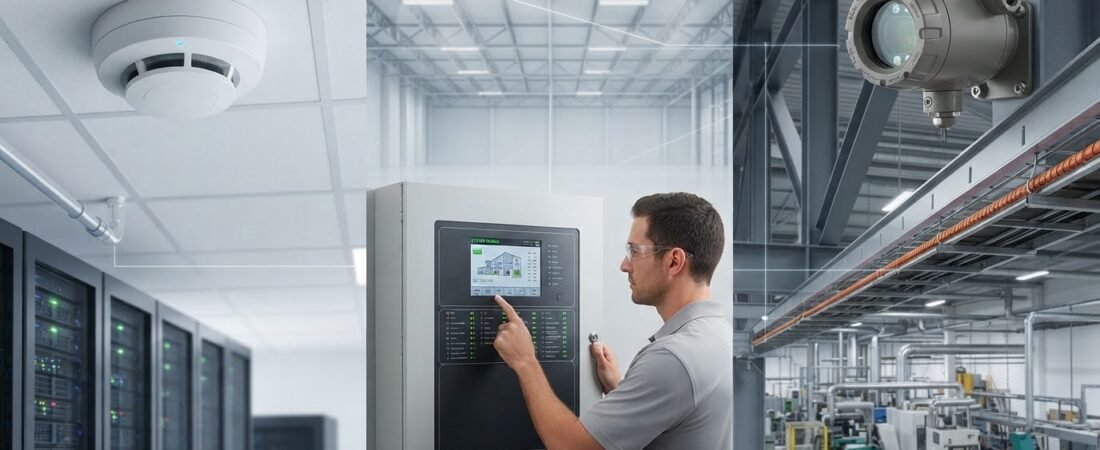
Selecting an effective fire detection system is never a one-size-fits-all decision. A sensor that works reliably in a quiet corporate office can trigger constant false alarms in a dusty manufacturing plant—or fail to detect a fast-moving chemical fire in time. Matching detection technology to your facility’s environment, operational hazards, and ceiling geometry is critical for protecting lives, preserving business continuity, and meeting regulatory compliance.
Core Fire Detection Technologies
Before evaluating specific building types, it helps to understand how the primary detection technologies respond to different stages of a fire:
- Smoke Detectors (Photoelectric & Ionization): Photoelectric sensors excel at detecting slow, smoldering fires (such as overheated wiring or upholstery) by sensing light scattered by larger smoke particles. Ionization detectors respond faster to flaming fires with smaller combustion particles, though photoelectric or multi-criteria sensors are now standard in most commercial applications to reduce nuisance alarms.
- Heat Detectors (Fixed-Temperature & Rate-of-Rise): Rather than sensing combustion particles, heat detectors trigger when ambient temperatures reach a preset threshold (e.g., 57°C / 135°F) or spike rapidly within a short window. They are ideal where dust, steam, or exhaust fumes would overwhelm smoke sensors.
- Flame Detectors (UV, IR, and Multi-Spectrum UV/IR): Optical sensors that monitor specific ultraviolet and infrared wavelengths emitted by open flames. They provide millisecond-level response across wide areas, making them essential for high-hazard environments where fires escalate instantly.
- Aspirating Smoke Detection (ASD / VESDA): Active systems that continuously draw air samples through a network of small-bore pipes into a central, ultra-sensitive laser detection chamber. ASD identifies microscopic pre-combustion particles hours before visible smoke appears.
- Linear Heat Detection (LHD) & Beam Detectors: LHD uses heat-sensitive cables routed directly along high-risk equipment (like cable trays or conveyors), while optical beam detectors project an infrared beam across wide open spaces to detect smoke obscuration over long distances.
Matching Systems to Facility Types
| Facility Type | Primary Fire & Environmental Challenges | Recommended Detection System |
|---|---|---|
| Commercial Offices & Retail | Smoldering electrical/paper fires, occupied spaces, moderate ceiling heights | Addressable photoelectric smoke detectors paired with manual pull stations and voice evacuation |
| Warehouses & Logistics Hubs | High ceilings (stratification), wide floor plans, forklift exhaust, dust | Projected optical beam detectors, air-sampling (ASD) systems, and in-rack linear heat cables |
| Manufacturing & Industrial Plants | Heavy airborne dust, welding sparks, steam, chemical vapors, machinery heat | Rate-of-rise heat detectors, multi-spectrum UV/IR flame detectors, and linear heat detection |
| Data Centers & Server Rooms | High-velocity HVAC airflow diluting smoke, high-value electronics, zero downtime tolerance | Very Early Warning Fire Detection (VEWFD) / Aspirating Smoke Detection (ASD) in return-air grilles and under raised floors |
| Commercial Kitchens & Food Processing | Cooking grease, heavy steam, rapid ambient temperature swings, washdown moisture | Fixed-temperature heat detectors (rated for high ambient heat) and wet-chemical hood suppression integration |
| Oil, Gas & Chemical Storage | Flammable liquids/gases, explosive atmospheres (ATEX/IECEx zones), outdoor exposure | Explosion-proof (Ex-rated) triple-IR (IR3) or UV/IR flame detectors combined with combustible gas detection |
| Healthcare & Hospitality | Vulnerable occupants requiring phased evacuation, nuisance alarms from showers/steam | Multi-criteria (smoke + heat + CO) addressable detectors to distinguish real fires from steam or aerosols |
Key Selection Factors Beyond Floor Plan
Even within the same industry, building specifics dictate system engineering:
- Ceiling Height and Airflow Dynamics: Smoke cools and loses buoyancy as it rises, often stalling below high ceilings—a phenomenon known as thermal stratification. Facilities with ceilings over 9 to 12 meters (30–40 feet) typically require beam detectors or aspirating systems rather than standard spot smoke detectors. Similarly, high air-change rates in cleanrooms or server halls can pull smoke away from ceiling sensors before it accumulates.
- Addressable vs. Conventional Architecture: Conventional panels divide a building into broad zones, telling responders which floor or wing triggered an alarm. Addressable systems assign a unique digital ID to every individual device, pinpointing the exact room or piece of equipment in alarm and monitoring sensor contamination levels before faults occur. For medium-to-large facilities, addressable systems drastically reduce troubleshooting and response times.
- False Alarm Mitigation: Frequent nuisance alarms lead to “alarm fatigue,” where occupants ignore alerts or staff illegally disable devices. In environments with steam, dust, or aerosols, multi-criteria detectors—which cross-reference optical smoke readings with thermal and carbon monoxide (CO) data—significantly cut false triggers while maintaining rapid response to genuine fires.
- Codes, Standards, and Integration: Your detection architecture must align with applicable local building regulations and international benchmarks such as NFPA 72 (National Fire Alarm and Signaling Code) or SNI / EN 54 standards. Equally important is seamless integration with building management systems (BMS) to automatically shut down HVAC dampers, recall elevators, unlock access-controlled doors, and trigger suppression systems.
Moving Toward an Engineered Design
Choosing the right fire detection system starts with a thorough Fire Risk Assessment that maps out fuel loads, ignition sources, ambient conditions, and occupant evacuation needs. Consulting a qualified fire protection engineer ensures your sensor placement, spacing, and panel architecture not only pass authority inspections on the first review, but perform reliably when every second counts.