Fire alarm systems play a critical role in protecting people, property, and business operations from fire hazards. As building technologies continue to advance, wireless fire alarm systems have become an increasingly popular alternative to conventional wired systems. By using radio frequency (RF) communication instead of extensive physical cabling, these systems offer greater installation flexibility and can simplify fire protection upgrades, particularly in existing buildings.
However, despite their advantages, wireless fire alarm systems also present certain challenges that must be considered before implementation. Understanding their benefits and limitations is essential when selecting the right fire detection solution for a building.
What Are Wireless Fire Alarm Systems?
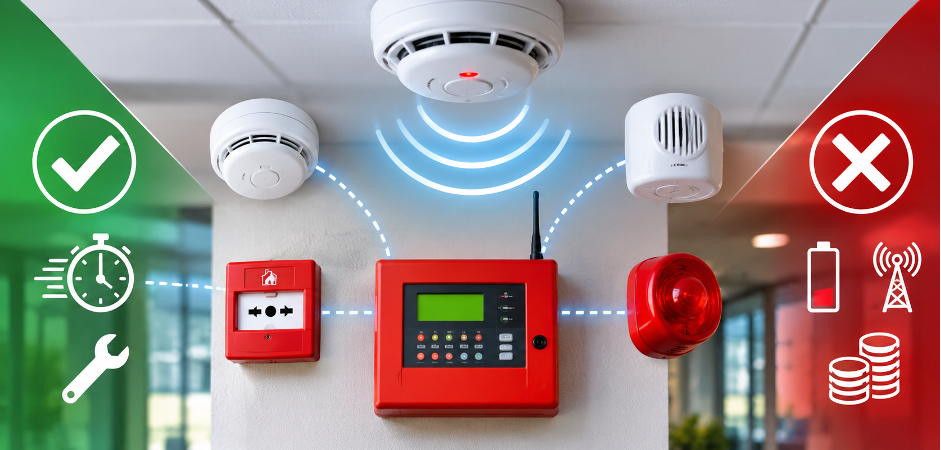
Wireless fire alarm systems are fire detection and alarm networks that communicate through radio signals rather than relying on traditional cables to connect every device. These systems typically consist of wireless smoke detectors, heat detectors, manual call points, sounders, and a central fire alarm control panel.
When a detector identifies signs of fire, such as smoke or abnormal heat, it transmits a signal to the control panel, which processes the information and activates the appropriate alarms. Depending on the system design, wireless devices may communicate directly with the control panel or through intermediate devices to maintain reliable signal coverage.
Modern wireless fire alarm systems are designed with monitoring features, signal supervision, and battery status notifications to help maintain system reliability.
Advantages of Wireless Fire Alarm Systems
- Faster and More Flexible Installation
One of the main advantages of wireless fire alarm systems is their relatively simple installation process. Since extensive cabling is not required, installation can be completed more quickly and with less disruption to building operations.
This is particularly beneficial in occupied buildings, offices, hotels, and commercial facilities where installing new cables could interfere with daily activities.
- Reduced Installation Costs in Certain Buildings
Wireless systems can reduce costs associated with cable installation, electrical containment, drilling, and structural modifications. This makes them especially attractive for buildings where running cables would be complicated or expensive.
Although wireless equipment may have a higher initial purchase price, the overall project cost can be competitive when installation and renovation expenses are considered.
- Suitable for Historic and Existing Buildings
Buildings with architectural restrictions, decorative interiors, or limited access to structural spaces can be difficult to upgrade with conventional wired systems.
Wireless fire alarm systems provide an alternative because they require minimal physical modifications. They are particularly useful in heritage buildings, museums, hotels, and renovated properties where preserving the original structure is important.
- Greater Flexibility for Future Changes
Wireless devices can generally be relocated or added more easily than wired devices when building layouts or operational requirements change.
This flexibility is valuable for commercial spaces, temporary facilities, and businesses that frequently renovate or expand their premises. It also makes system modifications less disruptive.
- Reduced Physical Infrastructure
Without extensive signal cabling, wireless systems require less physical infrastructure throughout the building. This can help maintain cleaner interiors, reduce cable congestion, and simplify installation in areas with limited space for additional wiring.
Disadvantages of Wireless Fire Alarm Systems
- Dependence on Battery Power
Wireless fire alarm devices typically rely on batteries for operation. These batteries require regular monitoring, maintenance, and replacement to ensure that detectors and other devices remain functional.
If battery levels are not properly managed, devices may eventually stop operating as intended. Therefore, scheduled inspections and battery condition monitoring are essential.
- Potential Radio Signal Interference
Wireless communication can be affected by physical obstacles and electromagnetic interference. Thick concrete walls, metal structures, reinforced building materials, and other electronic equipment may weaken or disrupt radio signals.
This can create communication challenges in large or complex buildings. Proper wireless coverage planning and signal testing are necessary to minimize these risks.
- Higher Equipment Costs
Wireless detectors and communication devices can be more expensive than their conventional wired equivalents. For large facilities requiring numerous detectors and alarm devices, the initial equipment investment may become substantial.
Consequently, a detailed cost comparison should consider both equipment prices and installation expenses before choosing a system.
- Maintenance and System Monitoring Requirements
Although wireless systems can simplify installation, they still require regular maintenance. Battery conditions, communication signals, device performance, and system faults must be inspected to ensure reliable operation.
Maintenance procedures may also require specialized knowledge of wireless communication technologies and manufacturer-specific equipment.
- Limitations in Large or Complex Buildings
Wireless systems may require additional signal repeaters or carefully planned communication networks to provide adequate coverage across large facilities.
Buildings with multiple floors, extensive concrete structures, underground areas, or significant metal obstructions may require more complex system designs. In some situations, a conventional wired system or a hybrid solution may be more practical.
Wireless vs. Wired Fire Alarm Systems
Both wireless and wired fire alarm systems can provide effective fire detection and notification when properly designed, installed, and maintained. However, their suitability depends on building conditions, project requirements, and long-term operational considerations.
| Comparison | Wireless System | Wired System |
| Installation | Generally faster and less disruptive | Requires cable routing and installation |
| Initial equipment cost | Often higher | Often lower |
| Cabling requirements | Minimal signal cabling | Extensive cabling |
| Flexibility | Easier to relocate or expand | Modifications can be more complex |
| Power supply | Typically battery-powered devices | Commonly powered through system wiring, with backup batteries at the control panel |
| Signal reliability | Depends on wireless coverage and communication quality | Depends on cable integrity and system design |
| Maintenance | Includes battery and signal monitoring | Includes cable and device inspections |
Neither technology is universally better. The most appropriate solution depends on the building’s layout, construction materials, budget, and fire safety requirements.
Key Considerations Before Installation
Before implementing a wireless fire alarm system, several factors should be evaluated to ensure that the system provides adequate protection.
- Building Assessment: Evaluate the building layout, construction materials, occupancy, and potential fire hazards to determine whether wireless communication is suitable.
- Signal Coverage: Conduct radio frequency surveys and testing to identify potential interference or weak communication areas.
- System Compatibility: Ensure that all wireless devices are compatible with the fire alarm control panel and designed to operate as an integrated system.
- Battery Management: Establish inspection schedules and battery replacement procedures to maintain continuous device operation.
- Regulatory Compliance: Ensure the system meets applicable fire safety regulations, installation standards, and relevant manufacturer requirements.
- Professional Installation: Engage qualified fire protection professionals to design, install, test, and commission the system.
Conclusion
Wireless fire alarm systems offer a flexible and practical solution for modern fire protection, particularly in existing buildings, heritage properties, and facilities where conventional cabling is difficult to install. Their advantages include faster installation, reduced structural modifications, and easier system expansion.
Nevertheless, considerations such as battery maintenance, radio signal interference, equipment costs, and building complexity must not be overlooked. Selecting between wireless, wired, or hybrid fire alarm systems requires a thorough assessment of the facility’s specific requirements.
Ultimately, the effectiveness of any fire alarm system depends not only on the technology used but also on proper system design, professional installation, regular maintenance, and compliance with applicable fire safety standards. A well-planned fire detection system is essential to ensuring early warning, protecting occupants, and reducing potential property damage.