
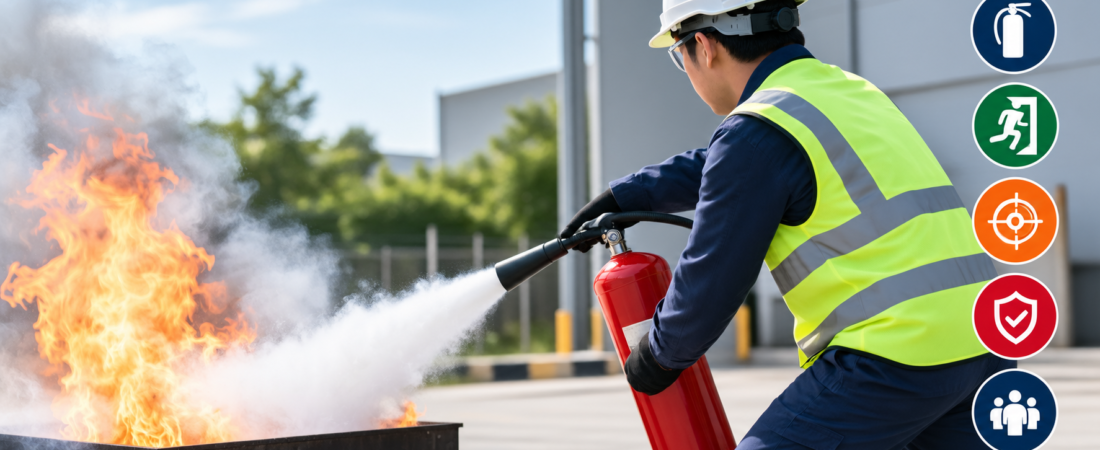
Knowing where a fire extinguisher is located is only the first step in workplace fire preparedness. In an actual emergency, staff must be able to recognize the type of fire, select an appropriate extinguisher, maintain a safe position, and operate the equipment effectively under pressure.
Advanced extinguisher handling is not about encouraging employees to fight larger fires. Rather, it is about improving decision-making, technique, and situational awareness when a small, incipient-stage fire can potentially be controlled safely.
- Assess the Fire Before Reaching for an Extinguisher
The first advanced skill is knowing when not to use an extinguisher.
Before approaching a fire, staff should quickly assess:
-
- What material is burning?
- Is the fire still small and localized?
- Is there a clear escape route behind them?
- Is smoke limiting visibility or breathing?
- Could the fire spread rapidly?
- Is the correct extinguisher available?
- Has the building’s emergency response procedure been activated?
If the fire is growing rapidly, producing heavy smoke, blocking an escape route, or otherwise becoming unsafe, employees should evacuate and allow trained emergency responders to handle it.
- Match the Extinguisher to the Fire
Using the wrong extinguisher can be ineffective or create additional hazards.
Common fire categories include combustible materials such as paper and wood, flammable liquids, flammable gases, energized electrical equipment, and cooking oils or fats. Different extinguishing agents are designed for different hazards.
Staff should therefore be trained to recognize the extinguisher types available in their workplace and understand their intended applications.
For example, a workplace may use:
-
- Water extinguishers for suitable ordinary combustible materials.
- Foam extinguishers for certain Class A and flammable-liquid hazards.
- Carbon dioxide (CO₂) extinguishers for suitable electrical and flammable-liquid applications.
- Dry chemical extinguishers for several types of fire, depending on the agent and certification.
- Wet chemical extinguishers for commercial cooking-oil and fat fires.
The exact extinguisher selection should always follow the equipment’s labeling, applicable standards, and the site’s fire-risk assessment.
- Improve Your Stance and Positioning
A common mistake is focusing entirely on the flames while forgetting personal positioning.
When conditions permit, staff should:
-
- Maintain a safe distance from the fire.
- Keep an unobstructed escape route behind them.
- Avoid positioning themselves where smoke is blowing toward them.
- Approach cautiously rather than rushing directly into the fire.
- Adjust their position as the fire changes.
Maintaining an escape route is particularly important. Employees should never allow themselves to become trapped between the fire and an exit.
- Use the PASS Technique Correctly
The familiar PASS method remains fundamental:
P — Pull the safety pin or activate the extinguisher’s locking mechanism.
A — Aim the nozzle or hose toward the base of the fire, rather than the top of the flames.
S — Squeeze the handle to discharge the extinguishing agent.
S — Sweep the nozzle from side to side across the base of the fire.
However, effective technique requires more than memorizing four words. Staff should understand why each step matters and practice the movements until they can perform them confidently.
- Control the Discharge Instead of Wasting the Agent
An extinguisher contains a limited amount of extinguishing agent. Pointing it randomly at the flames can quickly waste that capacity.
The discharge should be directed toward the area where the combustion process is being sustained. Staff should observe how the fire responds and maintain control of the extinguisher rather than simply emptying it continuously.
Training should also emphasize that extinguisher discharge patterns vary between equipment types. Employees should become familiar with the specific extinguishers installed at their workplace.
- Watch for Re-Ignition
A fire that appears to be extinguished may not be completely out.
Hot materials can continue smoldering and potentially reignite after the visible flames disappear. Staff should therefore monitor the affected area from a safe position rather than immediately assuming the emergency is over.
If the fire reignites or begins spreading, employees should prioritize evacuation and emergency response procedures.
- Understand the Limitations of Different Extinguishing Agents
Advanced training should explain not only what an extinguisher can do, but also what it cannot do.
For example, CO₂ extinguishers may be useful for certain electrical equipment and flammable-liquid fires, but they are not a universal solution for every workplace fire. Similarly, water should not automatically be used on every fire because certain electrical, flammable-liquid, or cooking-oil fires can present additional hazards.
Understanding these limitations helps employees avoid instinctive but dangerous responses.
- Consider Environmental Conditions
Real workplace fires rarely occur under perfect training conditions.
Staff may encounter:
-
- Poor visibility
- Heavy smoke
- Noise from alarms and machinery
- Crowded workspaces
- Slippery floors
- Heat radiation
- Moving equipment
- Panic among coworkers
Advanced drills should therefore include realistic environmental considerations without placing participants in unnecessary danger.
The objective is to develop calm decision-making under pressure—not to expose employees to uncontrolled fire conditions.
- Know When to Stop Fighting the Fire
One of the most important advanced techniques is recognizing when firefighting should end.
Employees should stop attempting to control a fire if:
-
- The fire is increasing in size.
- The extinguisher is ineffective.
- Smoke becomes excessive.
- Their escape route becomes threatened.
- Multiple extinguishers may be required.
- The fire involves hazards beyond their training.
- They are no longer confident that they can evacuate safely.
A workplace extinguisher is intended primarily for incipient-stage fires, not as a replacement for professional firefighting equipment and emergency response.
- Practice Through Hands-On Training
Reading an extinguisher procedure is very different from physically operating one.
Effective workplace training can include supervised practical exercises covering:
-
- Identifying different extinguisher types
- Checking extinguisher labels and condition
- Selecting the appropriate extinguisher for different scenarios
- Correct stance and positioning
- PASS technique
- Controlled discharge practice
- Recognizing when to retreat
- Post-use reporting and replacement procedures
Where practical fire simulation is conducted, it should be controlled by competent trainers using appropriate training equipment and safety procedures.
- Integrate Extinguisher Skills Into Emergency Procedures
Extinguisher handling should not exist as an isolated training topic.
Employees should understand how extinguisher use fits into the organization’s wider emergency response system, including:
-
- Raising the alarm
- Notifying emergency personnel
- Evacuation procedures
- Emergency exits and assembly points
- Communication with supervisors or emergency teams
- Accounting for personnel
- Reporting the incident afterward
The priority remains protecting people. Extinguisher use should only be considered when it can be done safely and within the employee’s level of training.
Building Confidence Without Creating Overconfidence
Advanced fire extinguisher training should create competence, not false confidence.
Employees need to understand that successfully controlling a small training fire does not mean they are equipped to confront a larger or rapidly developing workplace fire.
The most valuable skill is knowing how to make the right decision quickly: identify the hazard, choose the appropriate response, maintain a safe escape route, and evacuate when conditions exceed the limits of the training or equipment.
Conclusion
Advanced fire extinguisher handling combines technical operation with situational awareness, hazard recognition, positioning, and sound judgment. When employees understand both the capabilities and limitations of extinguishers, they can respond more effectively to small fires while avoiding unnecessary exposure to danger.
Regular hands-on training, realistic drills, proper equipment inspection, and clear emergency procedures can help turn basic extinguisher knowledge into practical workplace preparedness.
Related posts:
 School Fire Safety Protocols: Protecting Students and Staff
 Fire Safety Measures for Laboratories Handling Flammable Materials
 Proactive Fire Hazard Mitigation Techniques for Businesses
 How Smart Buildings are Adopting Advanced Fire Safety Measures
 The Essentials of Fire Extinguisher Training for Employees