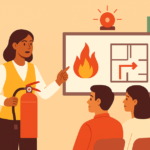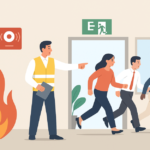
A fire drill is often treated as a routine safety requirement: an alarm sounds, employees leave the building, everyone gathers at the assembly point, and the drill is declared successful.
But a real fire does not follow a script.
Smoke can block familiar routes. Panic can slow decision-making. Emergency exits may become inaccessible, communication can break down, and employees may not know what to do beyond simply leaving the building.
This is why effective simulated fire drills should go beyond basic evacuation practice. A well-designed drill should test how people, procedures, communication systems, and emergency equipment perform when conditions become unpredictable.
Why Basic Fire Drills Are Not Enough
Traditional fire drills typically measure simple outcomes: How quickly did people evacuate? Did everyone reach the assembly point?
These measurements are useful, but they do not tell the whole story.
Employees may successfully complete a drill because they already know exactly what will happen. They may use their usual exit, follow colleagues, and arrive at the assembly point without encountering any complications.
During an actual emergency, however, conditions can change within seconds.
A blocked corridor, unfamiliar alarm signal, missing supervisor, power failure, or simulated smoke-filled area can dramatically affect how people respond.
A more advanced fire drill therefore asks a different question:
Can people make safe decisions when the situation does not go exactly as expected?
Introduce Realistic Scenarios
One of the most effective ways to improve a fire drill is to introduce a realistic scenario rather than simply announcing an evacuation.
For example, a drill could simulate:
- A fire starting in a common workplace area
- Smoke blocking the primary evacuation route
- An emergency exit becoming temporarily unavailable
- A missing employee who must be accounted for
- A fire alarm activation during a busy production period
- A power outage affecting normal building operations
- A visitor or contractor who is unfamiliar with evacuation procedures
The objective is not to create unnecessary fear. Instead, scenarios should encourage employees to apply their training and demonstrate whether emergency procedures actually work under pressure.
Test More Than Evacuation Speed
A fast evacuation is not necessarily a safe evacuation.
A comprehensive drill should evaluate several aspects of emergency response, including:
- Alarm Recognition
Do employees immediately recognize the alarm and understand what it means?
If different alarms are used for different emergencies, employees should know how to distinguish them and what action is expected. - Decision-Making
Do employees know what to do when their normal evacuation route is unavailable?
Training should encourage people to assess their surroundings, follow designated emergency procedures, and avoid dangerous shortcuts. - Emergency Communication
Communication becomes particularly important when an incident affects multiple departments or areas.
A drill can test whether supervisors, emergency response teams, security personnel, and management can communicate effectively during an evolving situation. - Accountability
Reaching the assembly point is only one part of evacuation.
Organizations should also verify whether employees, visitors, contractors, and other occupants can be accounted for accurately.
An unexplained absence should trigger the appropriate reporting procedure rather than encouraging untrained personnel to re-enter the building. - Emergency Response Teams
Fire drills should also evaluate the people responsible for managing the emergency.
Emergency response teams can be assessed on their ability to:- Receive and communicate information
- Assess the simulated situation
- Coordinate evacuation
- Support vulnerable occupants
- Communicate with security and management
- Use designated emergency equipment where appropriate
- Coordinate with external emergency services when required
Include Different Types of Occupants
Not everyone in a workplace responds to an emergency in the same way.
Employees may know the building well, while visitors, contractors, temporary workers, and new employees may not.
A realistic drill should therefore consider how unfamiliar occupants would receive instructions and reach a safe location.
Organizations should also consider people who may require additional assistance, including individuals with mobility, hearing, visual, or other accessibility needs.
Emergency procedures should be designed so that safety does not depend on everyone being able to respond in exactly the same way.
Use Drills to Test Emergency Equipment and Systems
A simulated emergency can also reveal weaknesses in safety infrastructure.
Depending on the scope of the drill, organizations can evaluate the effectiveness of systems such as:
- Fire alarm and notification systems
- Emergency lighting
- Exit signage
- Emergency communication systems
- Fire doors
- Evacuation routes
- Assembly-point procedures
- Fire detection systems
- Emergency response equipment
This does not mean every piece of fire protection equipment should be activated during every drill. Equipment testing should follow appropriate procedures and be conducted safely by qualified personnel.
The goal is to identify whether the systems employees depend on during an emergency are functioning as intended.
Measure Performance With Meaningful Indicators
Instead of recording only the total evacuation time, organizations can establish several performance indicators.
For example:
Response time:
How long did it take employees to recognize the alarm and begin responding?
Evacuation time:
How long did it take occupants to reach designated safe areas?
Accountability time:
How long did it take supervisors or emergency teams to confirm who was present?
Communication effectiveness:
Were emergency instructions delivered clearly and consistently?
Route effectiveness:
Did employees understand what to do when the primary route was unavailable?
Procedure compliance:
Did employees follow established emergency procedures?
These measurements provide a much clearer picture of the organization’s actual emergency readiness.
The Debrief Is Where Learning Happens
A fire drill should not end when everyone reaches the assembly point.
The post-drill review is one of the most important stages of the exercise.
Employees and emergency teams should discuss what worked, what caused confusion, and what could be improved.
Questions might include:
- Did everyone hear or recognize the alarm?
- Were evacuation routes clear?
- Did anyone hesitate because they were unsure what to do?
- Were visitors properly accounted for?
- Did supervisors communicate effectively?
- Were emergency exits clearly identified?
- Did any procedure create unnecessary delays?
- Did the emergency response team receive the information it needed?
Observations should then be documented and converted into corrective actions.
A drill that identifies a problem but does nothing to correct it has limited value.
Avoid Turning Drills Into Predictable Routines
Repeating exactly the same drill every time can create a false sense of preparedness.
Employees may learn the drill rather than learn how to respond to an emergency.
Organizations can periodically vary scenarios, evacuation routes, times, locations, and response challenges while maintaining appropriate safety controls.
However, drills should never be designed to intentionally create dangerous conditions or cause uncontrolled panic. Participants should understand that the exercise is a simulation, and organizers should have clear procedures for stopping the drill if an actual emergency occurs.
From Compliance to Readiness
Fire drills should not be viewed simply as a compliance exercise or an annual event that needs to be checked off a list.
Their greater value lies in revealing the gap between written emergency procedures and real-world human behavior.
A well-designed simulation can uncover problems that may otherwise remain invisible: unclear communication, ineffective evacuation routes, poor accountability, inadequate training, or employees who do not know how to react when circumstances change.
The ultimate objective is not to achieve the fastest evacuation time.
It is to build a workplace where people understand what to do, can make safe decisions under pressure, and know how their actions fit into the organization’s wider emergency response system.
The best fire drill is not the one where everything goes perfectly. It is the one that reveals what needs to be improved before a real fire exposes those weaknesses.